

The renewal call goes fine until your advertiser asks one question.
You’ve already sent the campaign report with impressions delivered, click rate, and a chart showing month over month lift. Then they ask which of their target accounts actually read the sponsored feature by name.
But nothing in your report can answer that question.
In B2B media, that gap costs you money. Your advertisers are not buying awareness. They are buying pipeline, and their own bosses measure them accordingly. I have spent more than two decades building digital publishing businesses, and reader experience has always been the part I care about most. Attention is the asset you already have, but proof is the part that has been missing.
This article covers what first-party data means inside a digital magazine, how dwell time becomes a qualification signal, and how to package both for the people buying your ad pages.
Why impressions stopped closing renewals
Your ad sales team is selling a metric your buyers have stopped trusting.
The erosion happened gradually rather than in a single event. Google reversed its plan to remove third-party cookies from Chrome and moved to a user-choice model instead, so technically the cookies are still there. Safari and Firefox, however, have blocked them by default for years. The practical result for digital advertising is a tracking signal that keeps narrowing.
Ask your advertisers what they actually want out of a campaign report, and the answers tend to cluster around four things:
- Named accounts rather than aggregate impressions
- Evidence of genuine attention, not just delivery
- Signals their own team can feed into lead scoring
- A privacy position their legal team can defend
Most of the ad tech in a typical magazine software stack was built to solve reach, and none of it was designed to answer the account-level question your advertiser is now asking.
What first-party data actually means for a magazine publisher
You already own the most valuable audience data in your category, and you’re probably not collecting it.
First-party data is information you gather directly, in your own environment, from readers you already have a relationship with. There’s no intermediary, no cookie syncing, and no inferred identity purchased from a broker.
For a digital magazine, that relationship starts at delivery. eMagazines sends each issue through a secure link tied to the subscriber rather than a public embed, so the reader is already known before the cover page loads. Compare that to a flipbook viewer, where every session starts anonymous and identity has to be reconstructed after the fact.
You can read more about how that password-free delivery model works for subscribers.
Why the reading experience decides the data quality
Attention data pulled from a pinch-and-zoom PDF is close to worthless, because a long time on page can just as easily mean the reader was fighting the layout.
That’s why a reflowed, single-column mobile optimized reader is a measurement prerequisite. Clean rendering is what makes the seconds you record mean something.
“Every publisher I talk to wants better identity resolution. The faster win is upstream. Know the reader at the moment of delivery, and you never have to reconstruct who they were.” — Lisa Pistilli, Director of Business Development at eMagazines
Dwell Data: engagement measured in seconds, not clicks
A click tells you someone was curious for a fraction of a second, but it cannot separate a misfire from a buying signal.
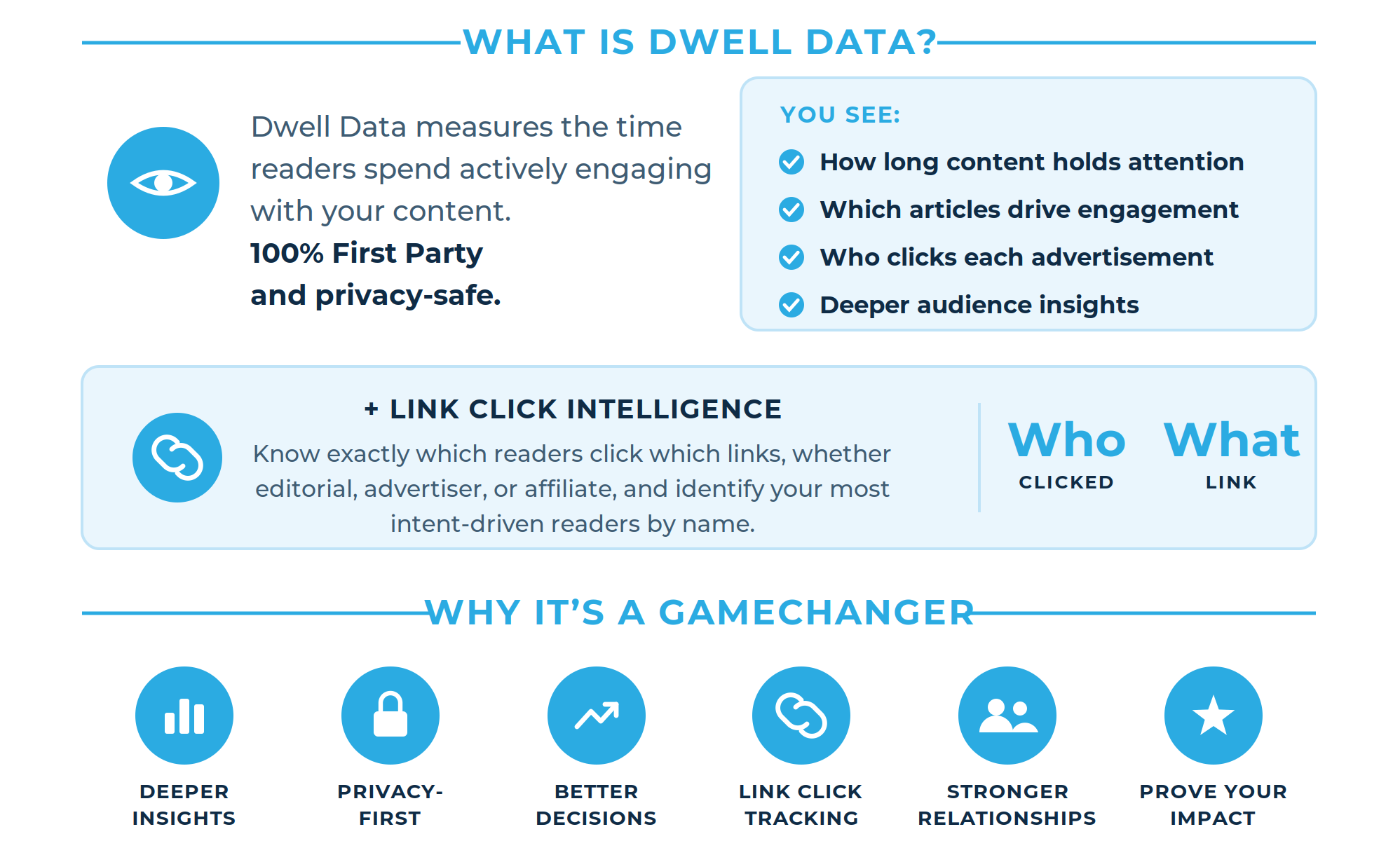
Dwell Data measures the time a reader spends actively engaging with a specific piece of content, captured entirely first party and privacy-safe. Paired with link click intelligence, it shows you:
- How long each article holds attention
- Which stories drive the deepest audience engagement
- Who clicks each advertisement, by name, whether or not they clicked
- Which links get clicked across editorial, advertiser, and affiliate placements
How dwell time compares to the metrics you already have
Put the four metrics side by side, and the gap becomes obvious.
| Metric | What it measures | What it proves to an advertiser | Limitation |
|---|---|---|---|
| Session duration | Time in the issue | Broad interest | No article-level view |
| Page views | Pages served | Reach | Attention is assumed |
| Click-through rate | A single moment of curiosity | Momentary interest | No depth, no identity |
| Dwell depth | Sustained attention per article | A named reader stayed and read, no click required | Requires a clean reader |
Your existing analytics and reporting already surface the first three, while dwell depth is the row that has been missing.
How advertiser lead qualification works in practice
Attention data only earns its keep when it leaves your dashboard and lands in your advertiser’s CRM, which happens in three stages.
Identify
You start with the readers spending meaningful time on advertiser-adjacent content, whether that’s sponsored articles, brand integrations, or dedicated pages. The list isn’t everyone who loaded the page, it’s the people who stayed.
This is the part most reporting cannot do. Identity does not depend on a click, so the readers who studied your advertiser’s page and never touched a link still show up by name. In B2B, those are often the researchers and evaluators who never click anything until the shortlist is already made.
Qualify
Dwell depth, link clicks, and return visits combine into an intent picture. Return visits carry particular weight in a B2B context, where purchases involve long cycles and multiple stakeholders. A reader coming back to the same sponsored feature is behaving very differently from a first-time skim.
Deliver
Qualified leads go to your advertiser with real names and real intent. Decide up front what you share, what stays yours, and how consent is handled, because that conversation belongs in the contract rather than in the first delivery email.
“Publishers keep pricing ad pages. Your advertiser is pricing outcomes. The publishers winning bigger contracts right now are the ones who changed what they are actually selling.” — Lisa Pistilli, Director of Business Development at eMagazines
What this changes for your rate card
Three revenue moves open up once you can prove attention at the account level.
- Premium pricing on sponsored content. Charge against proven dwell depth instead of estimated reach.
- Lead generation as a product line. Sell qualified leads alongside display, rather than throwing them in as a bonus to close the deal.
- Renewals backed by names. Walk into the conversation with evidence instead of an argument.
Picture a B2B title running a $15,000 quarterly sponsorship package. Adding a qualified lead deliverable to that package, priced against what your advertiser already pays for leads elsewhere, is where first-party data monetization becomes revenue rather than a reporting upgrade.
Analytics and monetization are now table stakes when publishers evaluate digital magazine platforms, but account-level lead qualification is not.
“The part about eMagazines Dwell Data that really matters to me is getting past the usual surface metrics. Page views are useful, but they don’t tell you whether someone actually spent time with the content.
If you can see how long a reader engaged, which articles held their attention, and who those readers are, that starts to tell a much more useful story. And when you can connect that behavior to the first-party demographic and professional data you already have, it gives advertisers something they increasingly want: a clearer sense of genuine interest, not just exposure.
To me, that makes the digital magazine much more than another awareness vehicle. It becomes a high-value intent channel that can show you which readers are really leaning in, and, within privacy constraints, help turn that engagement into highly qualified lead opportunities.” — Bill Levine, Director Advertising/Professional Media, Sage Publications
Three ways to put first-party data to work this quarter
You don’t need a full data strategy to get started, just three moves.
- Audit which sponsored placements actually hold attention. Click rate and dwell depth won’t rank your inventory the same way, so find out where they diverge before your advertiser does.
- Build dwell-based tiers into your packages. Price the placements that hold attention differently from the ones that don’t.
- Set consent and data-sharing terms before you sell. Your subscribers already access issues through secure, no-password links, so make the terms of what you share explicit in your privacy policy first.
Why most digital magazine platforms cannot offer this
The gap here is architectural rather than a missing feature on someone’s roadmap.
A platform that embeds a PDF in a viewer has no identity layer to attach behavior to and no reliable attention signal to measure. Tools built for one-off flipbooks and catalogs are designed around distribution rather than advertiser reporting. Neither starting point leads naturally to lead qualification, because the reader was anonymous from the moment the page loaded.
Turn your readers into your best advertising argument
The publishers who hold their ad revenue over the next few years will be the ones who can name their most engaged readers.
You already have the audience, and you already have the premium content that holds attention. What has been missing is the evidence.
If you’re interested, explore our 1-pager to learn more. And, when you’re ready, talk to our team about what Dwell Data would surface across your last four issues.